Article · AI and learning
Protect the effort that makes learning happen: what to hand to AI, what to keep demanding
© Pablo Correa Prieto, 2026 — CC BY 4.0
In my first article, I wrote that not everything that saves pupils time helps them learn. Part of the effort (searching, getting it wrong, rephrasing) is precisely what produces learning. This is not a teacher’s nostalgia: it is one of the most robust findings in the psychology of learning. And the first studies on AI in the classroom point the same way.
1.Performance in the moment is not learning
Elizabeth and Robert Bjork (2011) put it as a warning: performance during learning can be a very unreliable indicator of what has actually been learned. Conditions that make a task harder and slow apparent progress often improve long-term retention and transfer. They call these desirable difficulties.
Two classic effects illustrate this. The first is the generation effect: across five experiments, words that participants produced themselves were remembered better than the same words simply read (Slamecka & Graf, 1978). The second is the testing effect: students who had tested themselves on a text recalled 56% of its ideas a week later, against 42% for those who had reread it, even though rereading made them more confident in their memory (Roediger & Karpicke, 2006).
Bjork and Bjork draw a direct consequence: every time we get an answer we could have produced ourselves, we lose a chance to learn. With an important limit: a difficulty is only desirable if the pupil has the knowledge to overcome it. Otherwise, it is simply a difficulty.
2.With AI: a crutch or a tutor
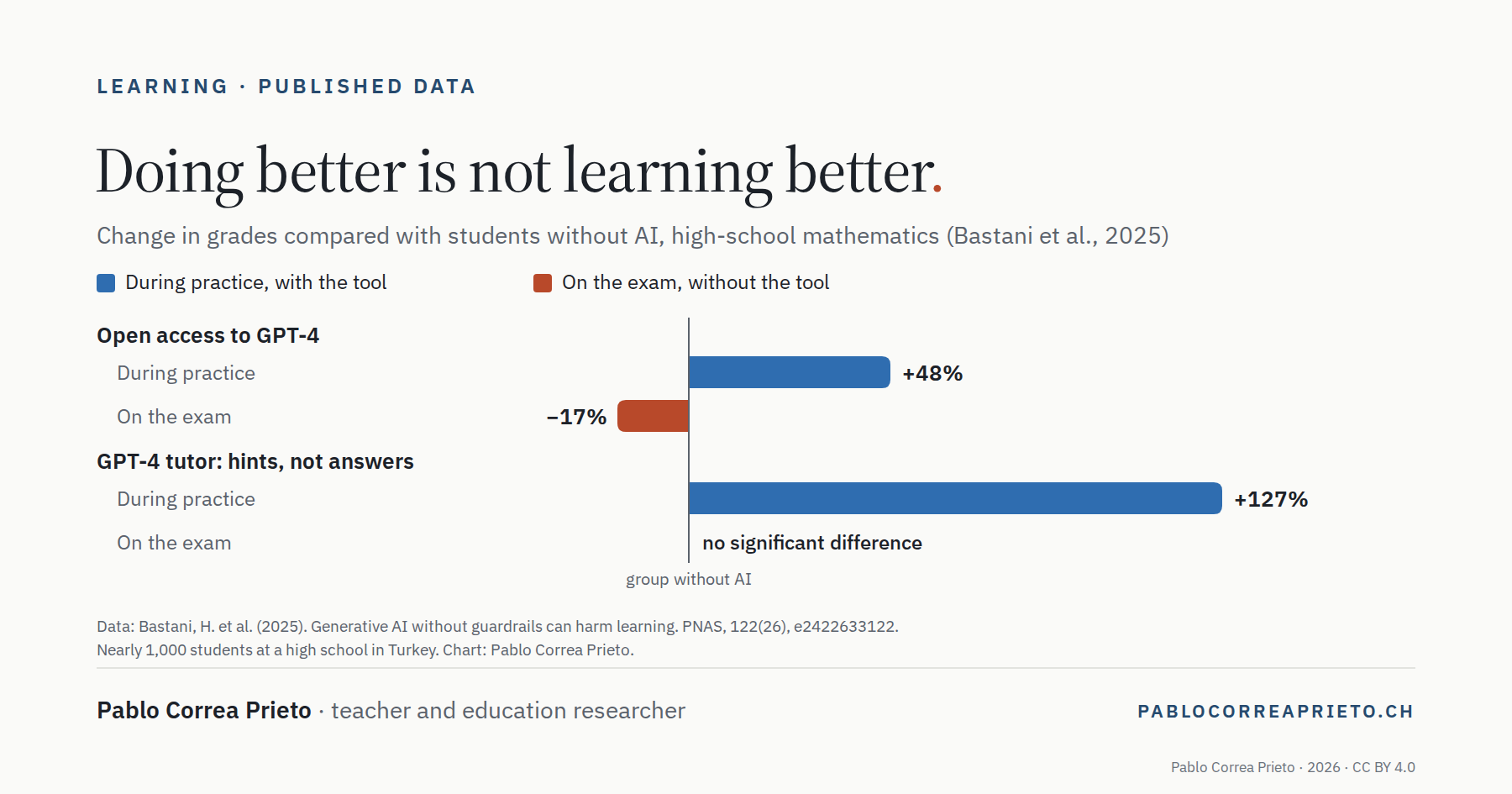
A study in a large high school in Turkey, with nearly 1,000 maths students, shows what this means with generative AI (Bastani et al., 2025). During practice sessions, open access to GPT-4 raised grades by 48%. But on the following exam, without the tool, these students scored 17% lower than students who never had access: the authors describe AI being used as a crutch. A version designed to give hints without handing over the answer raised practice grades by 127% and removed this negative effect on the exam, without doing better than the group without AI.
© Pablo Correa Prieto, 2026 — CC BY 4.0
Another study, at Harvard, found a more favourable result: with an AI tutor built on specific teaching principles, students in a physics course learned more, in less time, than in an active-learning class (Kestin et al., 2025). But the tests took place after each lesson, with no measure of longer-term retention, and the authors themselves advise against using AI where students are likely to use it as a crutch to get around thinking.
The same pattern shows up outside mathematics: students who researched a question with ChatGPT rather than a search engine experienced a lower cognitive load, but produced lower-quality reasoning (Stadler et al., 2024). Kapur (2016) sums it up: learning and performance are not always the same thing, and the conditions that maximise immediate performance do not necessarily maximise long-term learning.
3.What to hand to the tool, what to keep demanding
So the real teaching question is not “AI or no AI”, but: in a given task, is the effort required the effort that produces learning? Here is my proposal for the classroom.
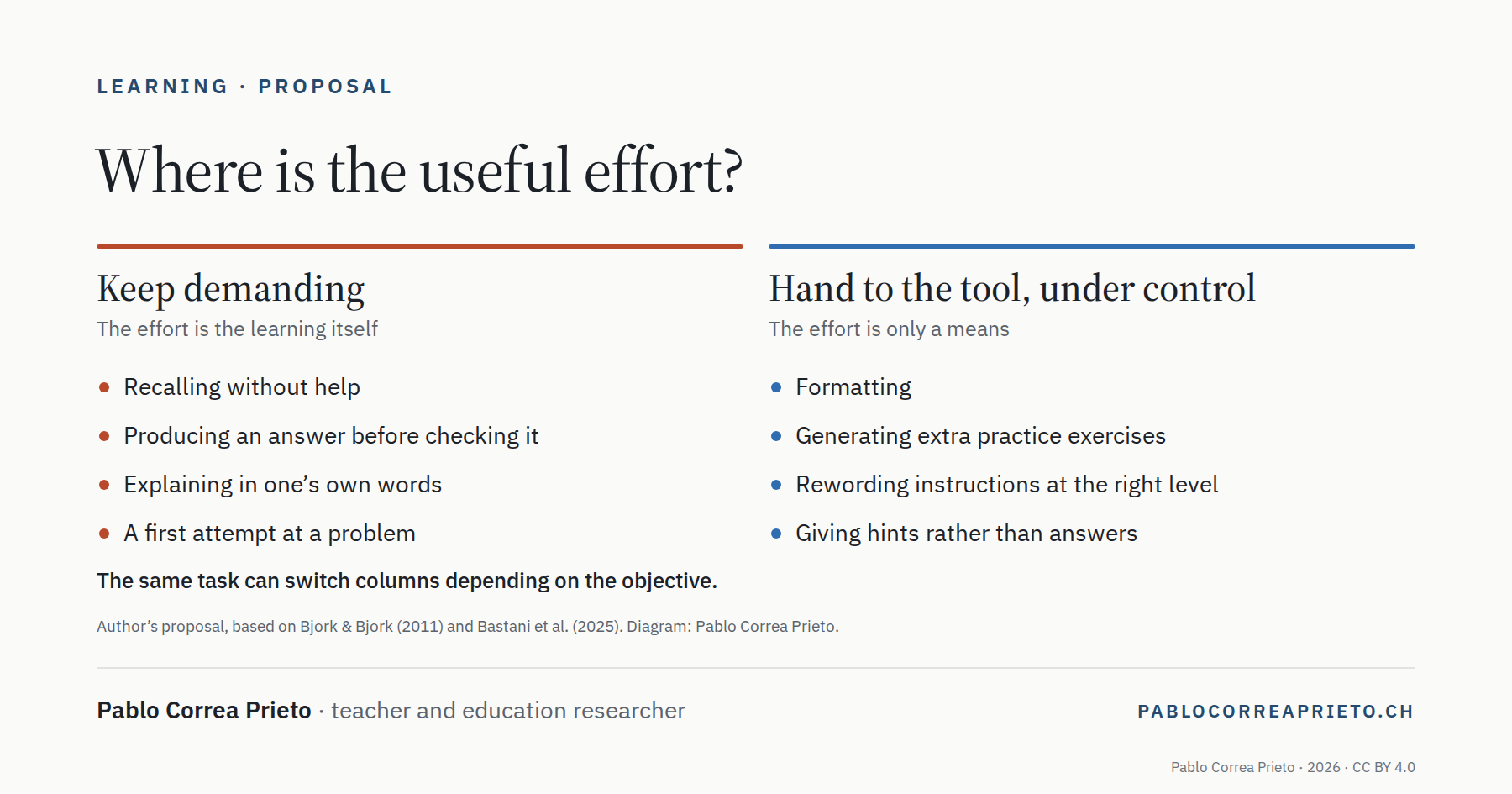
- Keep demanding whatever is the learning itself: recalling without help, producing one’s own answer before checking it, explaining in one’s own words, making a first attempt at a problem.
- Hand to the tool, under the teacher’s control, whatever is only a means: formatting, generating extra practice exercises, rewording instructions at the right reading level.
- When pupils use AI, prefer uses that give hints rather than answers, and then check what they can do without the tool.
© Pablo Correa Prieto, 2026 — CC BY 4.0
This is not a universal rule. The same task can be central in one sequence and incidental in another: rewording a text is the goal of a language lesson, but only a means in a science problem. It is up to the teacher to decide, objective by objective, where the useful effort lies.
Let’s talk
How do you protect useful effort in your classes when pupils have access to AI? I would be glad to discuss it. My contact details: pablocorreaprieto.ch
Text written with the help of AI, reviewed and approved by the author.
References
- Bastani, H., Bastani, O., Sungu, A., Ge, H., Kabakcı, Ö., & Mariman, R. (2025). Generative AI without guardrails can harm learning: Evidence from high school mathematics. Proceedings of the National Academy of Sciences, 122(26), Article e2422633122. https://doi.org/10.1073/pnas.2422633122
- Bjork, E. L., & Bjork, R. A. (2011). Making things hard on yourself, but in a good way: Creating desirable difficulties to enhance learning. In M. A. Gernsbacher, R. W. Pew, L. M. Hough, & J. R. Pomerantz (Eds.), Psychology and the real world: Essays illustrating fundamental contributions to society (pp. 56–64). Worth Publishers.
- Kapur, M. (2016). Examining productive failure, productive success, unproductive failure, and unproductive success in learning. Educational Psychologist, 51(2), 289–299. https://doi.org/10.1080/00461520.2016.1155457
- Kestin, G., Miller, K., Klales, A., Milbourne, T., & Ponti, G. (2025). AI tutoring outperforms in-class active learning: An RCT introducing a novel research-based design in an authentic educational setting. Scientific Reports, 15, Article 17458. https://doi.org/10.1038/s41598-025-97652-6
- Roediger, H. L., III, & Karpicke, J. D. (2006). Test-enhanced learning: Taking memory tests improves long-term retention. Psychological Science, 17(3), 249–255. https://doi.org/10.1111/j.1467-9280.2006.01693.x
- Slamecka, N. J., & Graf, P. (1978). The generation effect: Delineation of a phenomenon. Journal of Experimental Psychology: Human Learning and Memory, 4(6), 592–604. https://doi.org/10.1037/0278-7393.4.6.592
- Stadler, M., Bannert, M., & Sailer, M. (2024). Cognitive ease at a cost: LLMs reduce mental effort but compromise depth in student scientific inquiry. Computers in Human Behavior, 160, Article 108386. https://doi.org/10.1016/j.chb.2024.108386