Article · AI and the teacher’s work
What AI really changes for teachers who prepare and assess
© Pablo Correa Prieto, 2026 — CC BY 4.0
Since June, I have been teaching as a substitute in Vaud schools. The role has one particular feature: you have to prepare quickly, for classes you don’t know, while respecting the curriculum and what the regular teacher has already built. That is exactly where generative AI tools promise the most, and that is where I watch them closely.
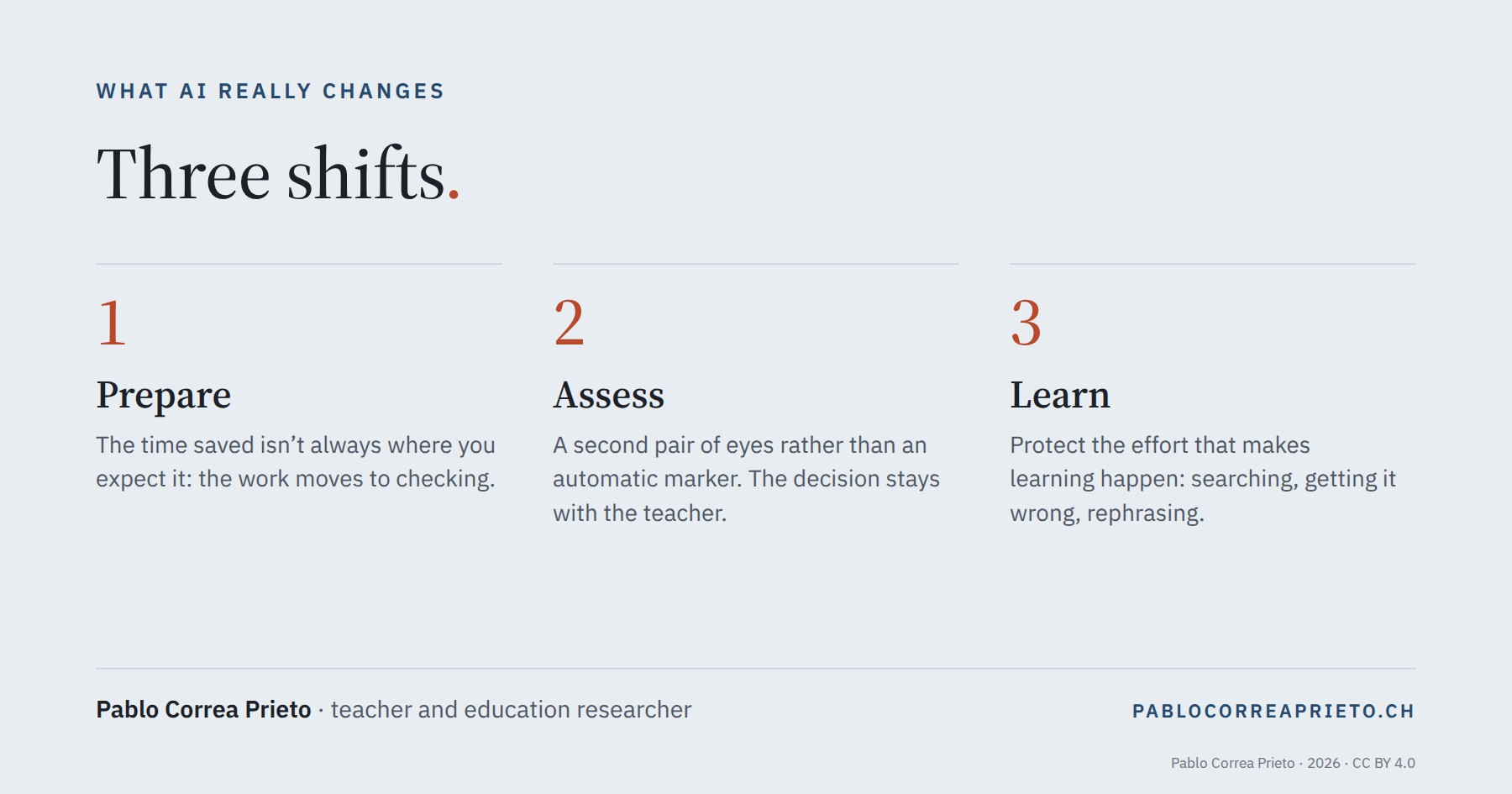
The public debate often comes down to “for or against AI in schools”. I think that is the wrong question. The tools are already here; what matters is what they actually change in the teacher’s work and in pupils’ learning. I see three shifts.
© Pablo Correa Prieto, 2026 — CC BY 4.0
1.Prepare: the time saved isn’t always where you expect it
Generating a set of exercises, a differentiated version or a reworded instruction now takes a few seconds. But the work does not disappear: it shifts towards checking. A correct exercise is not necessarily aligned with the objective set by the PER, nor pitched at the right level of demand for the class. The real gain therefore depends on how quickly the teacher can judge what is put in front of them, and that is a professional skill in its own right.
2.Assess: a second pair of eyes rather than an automatic marker
AI is often compared with an error-free ideal. The honest comparison is with our own practice: fatigue at the bottom of a pile of papers, criteria we sometimes apply unevenly, a typo in a task. On that ground, I think AI is still underrated, particularly as a second pair of eyes that spots what we miss. On one condition: pupils’ data protection must be respected. The decision stays with the teacher.
3.Learn: protect the effort that makes learning happen
Not everything that saves pupils time helps them learn. Part of the effort (searching, getting it wrong, rephrasing) is precisely what produces learning. The real pedagogical question becomes: which tasks should be handed to the tool, and which should deliberately stay demanding?
What I am studying
Alongside my master’s in education research (UNIR), I am preparing a paper on a specific question: can large language models produce mathematics assessment items (cycle 3) that comply with the Plan d’études romand? I examine three dimensions: alignment with the PER objectives, the cognitive demand of the items and their quality. The aim is not to replace the teacher who designs their assessments, but to find out what these tools are really worth when they are held to the requirements of the curriculum.
Let’s talk
Teachers, school leaders, teacher educators, researchers: if you use these tools to prepare or assess, or if you work on these questions in French-speaking Switzerland, I would be glad to discuss them. My work and contact details: pablocorreaprieto.ch
Text written with the help of AI, reviewed and approved by the author.