Article · AI and lesson preparation
Preparing fast with AI: the real work is checking
© Pablo Correa Prieto, 2026 — CC BY 4.0
As a substitute teacher, I often prepare quickly, for classes I don’t know, while respecting the curriculum and what the regular teacher has already built. Generating a set of exercises with an AI tool now takes a few seconds. The time saved is real; but the work does not disappear, it moves. This article is also meant for school leaders: what distinguishes good use of AI in lesson preparation is not generating, it is checking.
1.The time saving is real
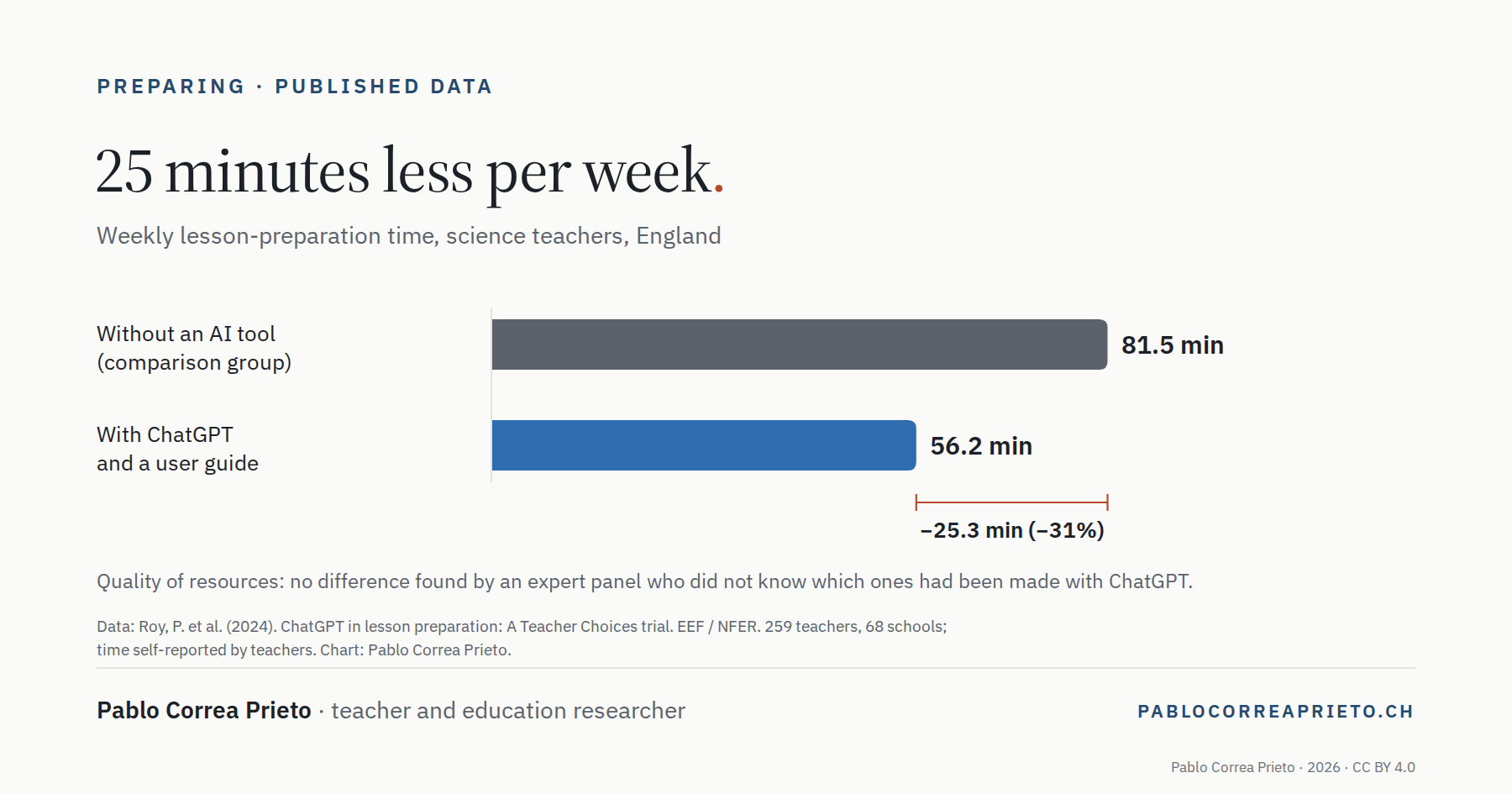
The most solid figure I know of comes from a controlled trial in England with 259 science teachers from 68 schools, teaching Year 7 and Year 8 pupils (Roy et al., 2024). Teachers who used ChatGPT with a guide spent 56.2 minutes a week preparing lessons and resources, against 81.5 minutes in the comparison group: 31% less. An expert panel, who did not know which resources had been made with ChatGPT, found no difference in quality.
© Pablo Correa Prieto, 2026 — CC BY 4.0
Two details matter. The time was reported by the teachers themselves, in a weekly diary. And the guide that came with the tool warned users to check what ChatGPT produces, because it can make mistakes. So the measured saving does not exclude checking: it was achieved by teachers who were told to check.
2.Check what? The objective and the level of demand
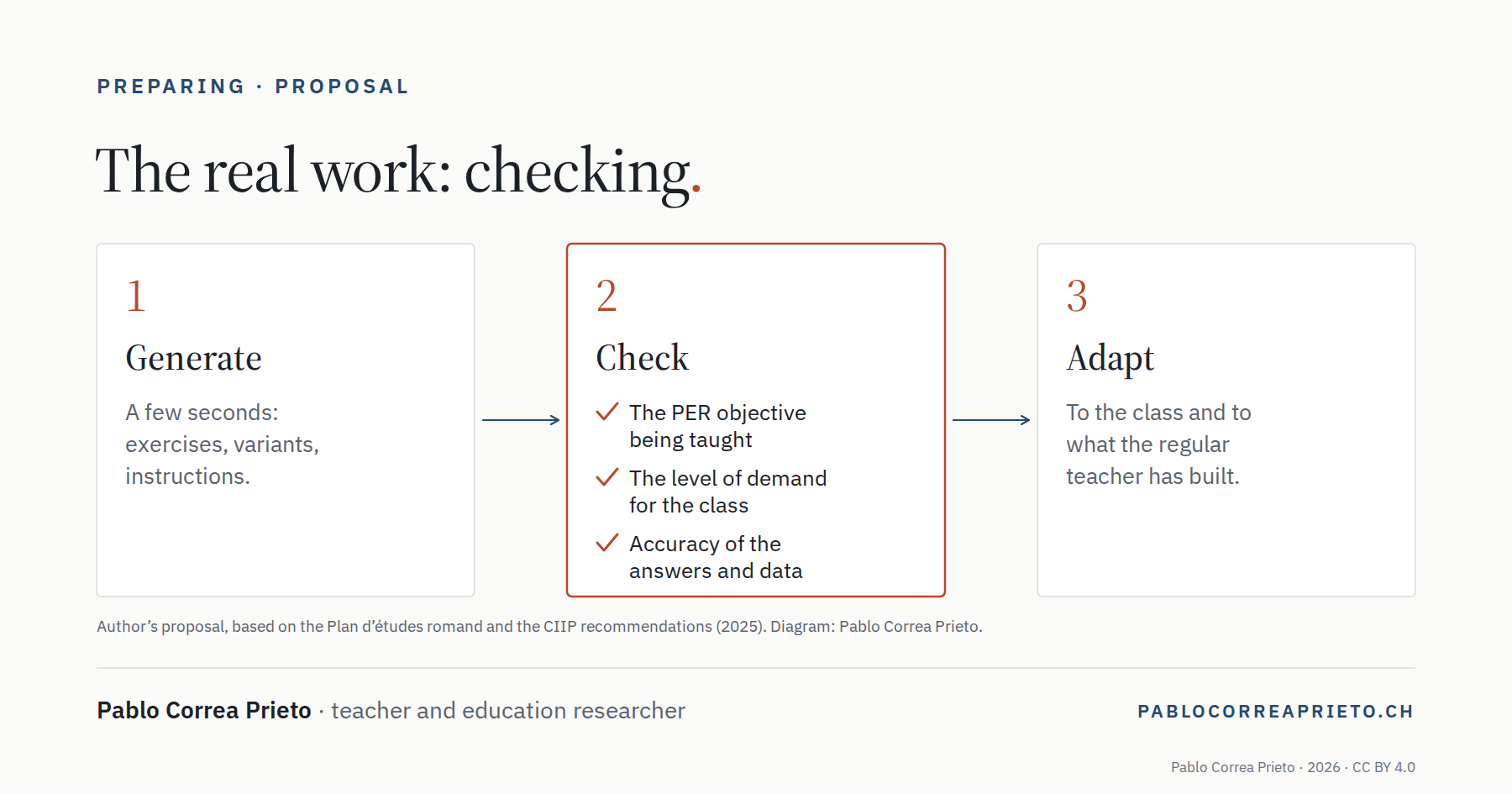
A correct exercise is not necessarily a good exercise for this class. The first check concerns the objective. For each subject, the Plan d’études romand (PER), the curriculum of French-speaking Switzerland, sets out learning objectives, a progression of learning (year by year in cycle 3) and essential expectations, that is, the learning needed to keep progressing (CIIP, n.d.). A correct exercise that misses the current objective wastes the class’s time. The CIIP (2025), which brings together the education departments of French-speaking Switzerland and Ticino, makes this a principle for using generative AI: ensuring internal coherence between learning objectives, teaching methods and assessment methods. It is the idea of alignment that John Biggs (1996) formulated for higher education, and it holds for compulsory schooling too.
The second check concerns the level of demand. In a study of 310 lesson plans generated by ChatGPT, Gemini and Copilot for US civics standards, 90% of the 2,230 activities were at the “remember”, “understand” or “apply” levels, and the plans rarely fostered higher-order thinking (Trust et al., 2025). The context is different from ours, but the risk is the same: correct activities that often demand little. Then the activities need adjusting to the real level of the class, which the tool does not know.
Last comes accuracy: expected answers, data, wording. It is the most obvious check, and often the quickest.
© Pablo Correa Prieto, 2026 — CC BY 4.0
3.Responsibility stays with the teacher
Official guidance agrees on this. For the CIIP (2025), using a generative AI tool makes you responsible for all the content it produces; it also stresses that its use falls within teachers’ professional autonomy and should be guided above all by the learning to be achieved. The Department for Education in England writes that “any content produced requires critical judgement to check for appropriateness and accuracy”, and that the quality of the final document remains the responsibility of the professional who produced it (Department for Education, 2025).
4.Judging quickly is a professional skill
This is where I see what is at stake for substitute teachers, and for the school leaders who hire them. When you arrive in an unfamiliar class, the added value does not lie in producing exercises: anyone can generate them now. It lies in judging quickly whether what is on offer fits the regular teacher’s objective, the level of the class and what has already been done. That is a professional skill in its own right, grounded in knowledge of the PER and experience of the class. I put it forward as a practitioner’s view: I know of no study that has measured it.
Let’s talk
School leaders, class teachers, fellow substitutes: how do you prepare continuity for a class when someone else takes over? I would be glad to discuss it. My contact details: pablocorreaprieto.ch
Text written with the help of AI, reviewed and approved by the author.
References
- Biggs, J. (1996). Enhancing teaching through constructive alignment. Higher Education, 32(3), 347–364. https://doi.org/10.1007/BF00138871
- Conférence intercantonale de l’instruction publique et de la culture de la Suisse romande et du Tessin [CIIP]. (2025). Intelligence artificielle générative – IAG : recommandations pour une utilisation réfléchie et mesurée dans l’enseignement. https://www.ciip.ch/files/1050/Documents/IRDP/Recommandations_IAG_19-03-2025_V10.pdf
- Conférence intercantonale de l’instruction publique et de la culture de la Suisse romande et du Tessin [CIIP]. (n.d.). Les domaines disciplinaires. Plan d’études romand. Retrieved September 28, 2026, from https://portail.ciip.ch/per/pages/245
- Department for Education. (2025). Generative artificial intelligence (AI) in education [Policy paper]. GOV.UK. https://www.gov.uk/government/publications/generative-artificial-intelligence-in-education
- Roy, P., Poet, H., Staunton, R., Aston, K., & Thomas, D. (2024). ChatGPT in lesson preparation: A Teacher Choices trial [Evaluation report]. Education Endowment Foundation. https://educationendowmentfoundation.org.uk/projects-and-evaluation/projects/choices-in-edtech-using-generative-ai-chatgpt-for-ks3-science-lesson-preparation-2024-teacher-choices-trial
- Trust, T., Maloy, R., Xu, C., & Pelletier, K. (2025). Civic education in the age of AI: Should we trust AI-generated lesson plans? Contemporary Issues in Technology and Teacher Education, 25(3). https://citejournal.org/volume-25/issue-3-25/social-studies/civic-education-in-the-age-of-ai-should-we-trust-ai-generated-lesson-plans/