Home / Training
Professional development · schools in the canton of Vaud and French-speaking Switzerland
AI training for your teaching team, from a teacher in the canton of Vaud
Three formats for school leadership teams and teaching staff. No tool to sell.
© Pablo Correa Prieto, 2026 — CC BY 4.0
The situation
Generative AI is already in your classrooms. The Swiss recommendations exist, but between the official texts and daily practice your teachers are left alone with concrete questions. What can I ask of my students? What still measures learning? What am I allowed to do with their data?
I teach in Vaud classrooms and I do education research on AI in schools. I have no tool to sell. I help your team decide what it does about AI, within the real institutional framework and with tasks that come from real classrooms.
Three formats
Format A · entry point
AI in the classroom. What the official texts say, what actually works.
Talk and workshop · 90 minutes · staff meeting or the opening of a professional development day
Establish a shared factual basis on what generative AI does and does not do, set out the Swiss institutional framework, and lower the tension between enthusiasts and sceptics.
Structure
- 20 min — capabilities and limits, demonstrated live on real curriculum tasks
- 25 min — the institutional framework: what the official texts permit, require and forbid
- 25 min — three classroom-ready uses and three things not to do
- 20 min — questions, structured around the most common objections
Your teachers leave with
- a one-page summary of the official Swiss texts
- a do-and-don’t sheet on student data
- three task templates aligned with the curriculum
Format B · hands-on workshop
Reworking your own assessments
Half day · 3 to 3.5 hours · groups by cycle
Each teacher brings their own material. The aim is that they leave with one of their lesson sequences or assessments reworked for a context where students have access to AI, and that they have handled a tool themselves within a compliant setting.
Structure
- short input, a condensed version of format A
- guided hands-on work on a real sequence the teacher brings
- redesigning an assessment: what still measures learning when students have access to AI?
- peer critique and individual commitments
Your teachers leave with
- one reworked task per participant
- an assessment redesign checklist
- a bank of prompt patterns aligned with the curriculum
- a follow-up email after four weeks
Format C · course
Through to an AI use policy for your school
Three 90-minute sessions across one term · classroom micro-experiments in between
The literature on professional development is consistent on this point: one-off sessions rarely change practice, while sustained formats anchored in practice do. This is the format that produces a lasting artefact for the school.
Structure
- session 1 — shared basis and a first classroom experiment assigned
- session 2 — debrief of what happened in the classrooms, going deeper on assessment and differentiation
- session 3 — consolidation and drafting of an AI use policy
Your school leaves with
- a draft AI use policy
- a log of the experiments run in classrooms
- a resource bank
Why me
- A practising teacher. First-hand knowledge of Vaud schools, of the Plan d’études romand, of Neo, of professional development days and of what a class will actually tolerate. No provider from outside the profession can say the same.
- Research on the official texts. I am currently working on an analysis of the texts that frame generative AI in French-speaking Switzerland — CIIP recommendations, CDIP texts, cantonal directives, HEP documents — as part of a paper in preparation. That work feeds directly into the content of these sessions.
- Independent of the tools. No licence to sell, no commercial partnership with a vendor. What I offer is professional judgement, not a product.
- Scepticism treated as data. Teachers’ divided attitudes towards AI are a legitimate research finding, not resistance to be corrected. It is also the subject of one of my works in progress on AI acceptance among in-service teachers.
Data protection
This is the question every school leader asks, and it is addressed first in every format.
The baseline rule: no personal student data — no scripts, names, marks or individual situations — goes into a consumer tool. Demonstrations and workshops use only anonymised or fictional examples, and every participant receives a written do-and-don’t sheet.
I propose no use that would fall outside cantonal directives, and I say so in the room when a common practice does not meet them.
Frequently asked questions
- HEP Vaud already runs AI training. Why bring in someone else?
- I work from the same official Swiss framework. What I add is a session built for your school, on the date of your professional development day, using material from your own cycles, delivered by someone currently teaching in Vaud classrooms. This complements the cantonal provision rather than replacing it.
- What about our students’ data?
- It is the first point covered in every format. The baseline rule is that no personal student data goes into a consumer tool. I work only with anonymised or fictional examples and I provide a written do-and-don’t sheet.
- Our teachers are deeply divided about AI. Is that a problem?
- No, and the research documents it. The format is designed for divided teams: nobody is converted, the session establishes facts, a framework and professional choices.
- Which tool do you recommend?
- None in particular. I have no commercial relationship with any vendor and no licence to sell. I cover categories of use and the criteria for choosing within cantonal rules.
- What does a session cost?
- On request, depending on the format, the number of participants and travel. The first sessions are delivered at a reduced pilot rate in exchange for written participant evaluations.
What these sessions are built on
The content comes from my own work on AI and assessment, published and explained on this site.
Arranging a session
Write to me with your school, the format you are interested in and the date you have in mind — a professional development day, a staff meeting or a full term. I reply with a detailed outline and a quote.
I am also happy to simply send you the outline of the three formats, with no commitment.
- pabcorpri@gmail.com
- Area
- Canton of Vaud and French-speaking Switzerland
- Audience
- School leadership teams, teaching staff, private schools, parent associations
- Languages
- French, Spanish, English
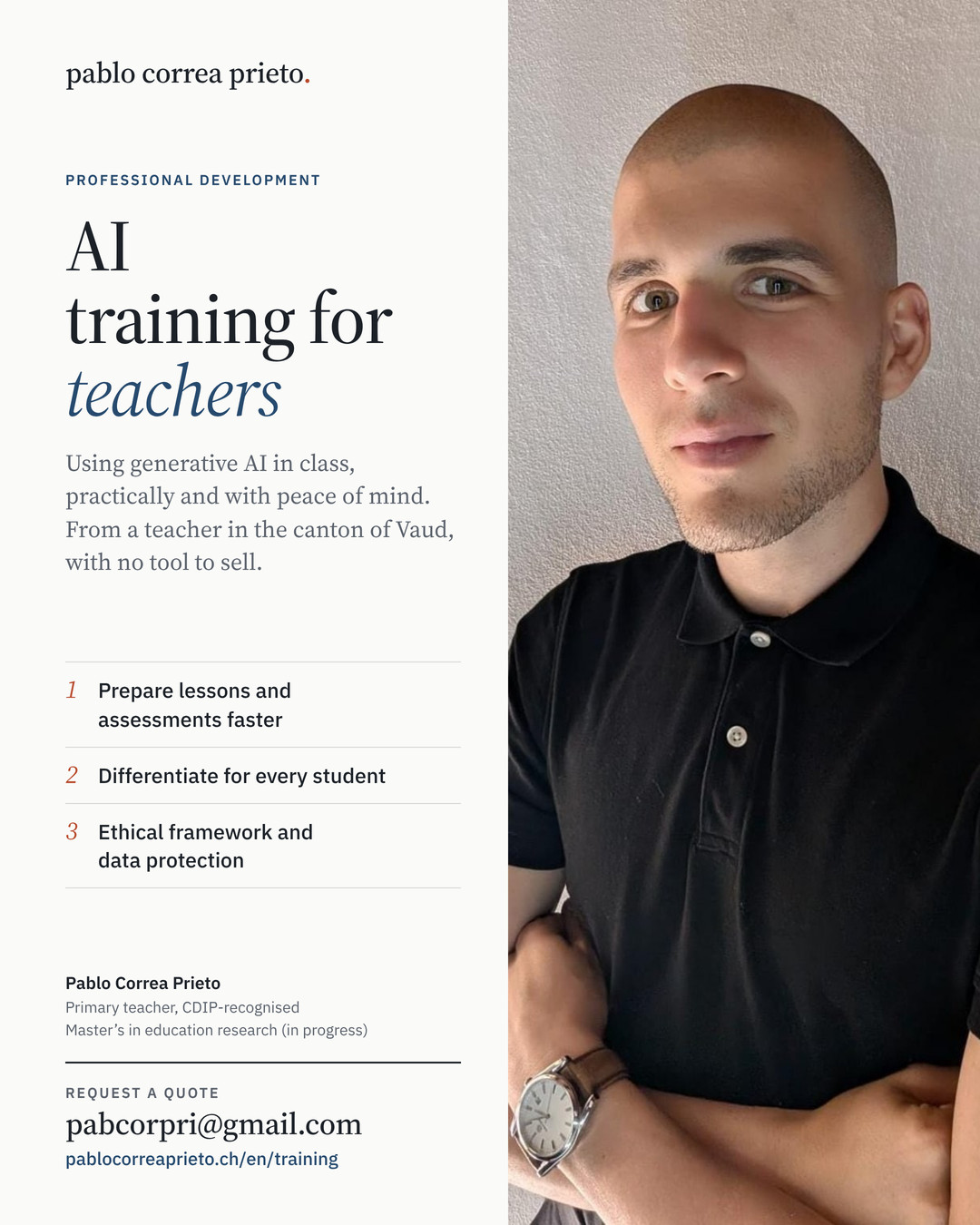
A poster to share
To present the training to your staff, you can download this poster and share it.